Temporary recruitment gives Kent businesses a direct process for matching workforce capacity to actual demand. Rather than carrying permanent headcount through quiet periods or losing revenue during peaks, employers can scale their teams precisely when workload requires it – without long-term financial commitment.

  • Temporary recruitment is a strategic workforce planning tool, not simply a short-term fix for unexpected absences.
  • Kent businesses across sectors including logistics, professional services, and administration use flexible staffing to protect productivity during seasonal and project-driven demand spikes.
  • The Agency Workers Regulations (AWR) and UK employment law provide a clear legal framework that protects both employers and temporary workers.
  • Partnering with a local recruitment specialist like TN Recruits means faster placement, pre-vetted candidates, and compliance handled on your behalf.
  • Temp-to-perm pathways allow employers to assess candidates in a live working environment before committing to a permanent offer.

The Challenge of Fluctuating Workloads for Kent Businesses

Kent’s position as a commercial gateway – connecting London to the south coast and mainland Europe via the Port of Dover – creates a business environment where demand rarely stays flat. Distribution, logistics, professional services, and hospitality firms across the county regularly face sharp increases in workload that their permanent teams cannot absorb alone. Carrying excess permanent headcount to cover these peaks is expensive. Leaving peaks unaddressed costs revenue and damages client relationships.

The 2025 employment market across Kent, Sussex, and Surrey has added further complexity. Wage inflation, tighter candidate availability, and the legislative changes introduced by the Employment Rights Bill have made permanent hiring a more considered decision. Many employers are responding by building a more agile talent model – one where a core permanent team is supported by a flexible layer of temporary workers who can be deployed quickly and scaled back without redundancy risk.

What are the common causes of workload fluctuations in Kent?

Seasonal retail and hospitality demand, project-based contracts in construction and professional services, staff absences during summer and school holidays, and sudden increases in order volumes from export-linked businesses all drive workload fluctuations across Kent. The county’s proximity to London also means many businesses experience demand cycles tied to the capital’s financial and commercial calendar.

In our experience working with businesses across Tunbridge Wells, Maidstone, and the wider Kent area, the most new peaks are rarely the ones employers plan for. A key account doubles its order volume. A project deadline moves forward. Three members of a small team take annual leave simultaneously. These are the moments where a pre-established relationship with a temps division that understands your business makes a measurable difference to how quickly you recover operational capacity.

Temporary Recruitment: A Strategic Solution for Workforce Agility

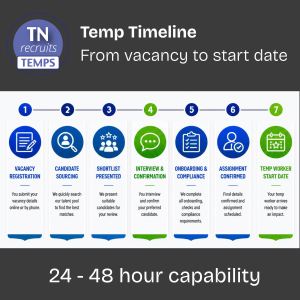
Temporary recruitment provides workforce agility by separating headcount decisions from long-term employment commitments. An employer can increase team capacity within 24 to 48 hours, deploy workers for a defined period, and return to core staffing levels once the demand cycle ends. The financial model is straightforward: the agency handles payroll, employer National Insurance contributions, and holiday pay accrual, removing administrative burden from the client.

This model is particularly relevant in 2026 as employers absorb the implications of the Employment Rights Bill. Understanding your obligations around the 2025 Employment Rights Bill is essential before expanding your temporary workforce – the legislation introduces new rights around zero-hours contracts and day-one protections that affect how temporary arrangements are structured.

How does temporary recruitment help with project-based work?

Temporary recruitment supports project-based work by providing skilled workers for a defined scope and duration, without the overhead of a permanent hire that becomes redundant once the project concludes. Employers can bring in specific competencies – data processing, administrative support, customer service – for the exact period the project requires, then release those workers cleanly at project end.

Fixed-term contracts and short-term placements are particularly effective for Kent businesses managing tender-driven workloads, where project start dates are confirmed at short notice and resource requirements are clearly scoped. TN Recruits maintains an active pool of pre-vetted candidates across administrative, professional, and support functions, which means project-specific placements can be made quickly without compromising on candidate quality.
Benefits of Flexible Staffing for Kent Businesses

Flexible staffing delivers measurable advantages across cost control, operational continuity, and talent acquisition. Employers who build temporary recruitment into their workforce planning – rather than treating it as a reactive measure – consistently report better outcomes across all three areas.

What are the benefits of flexible staffing for businesses in Kent?

Flexible staffing reduces fixed payroll costs during low-demand periods, protects service quality during peaks, and creates a pipeline of assessed candidates for permanent roles. Kent businesses also benefit from reduced recruitment risk – temporary placements allow employers to evaluate a worker’s performance, culture fit, and technical competence before making a permanent offer through a temp-to-perm arrangement.

Beyond cost, flexible staffing protects your permanent team. Sustained overwork drives burnout, increases absence rates, and accelerates staff turnover – all of which carry their own recruitment and training costs. By hiring a temp during high-demand periods, employers distribute workload more evenly, maintain morale within their core team, and avoid the compounding cost of losing experienced permanent staff to exhaustion-driven resignations.

Can temporary staff improve productivity during busy periods?

Temporary staff improve productivity during busy periods by absorbing task volume that would otherwise delay core team output or create a backlog. When a permanent team is stretched, response times slow, errors increase, and client-facing quality drops. A well-briefed temporary worker, placed quickly and matched accurately to the role requirements, restores operational capacity and allows the permanent team to focus on higher-value work.

The key variable is placement accuracy. A temporary worker placed in a role that does not match their skills creates more disruption than it resolves. TN Recruits’ screening process for temporary candidates includes skills assessment, reference verification, and a structured briefing on client requirements before the first day. This preparation reduces the time a temporary worker takes to become productive, which is the critical factor when the placement is driven by an urgent demand spike.

How to Implement a Flexible Staffing Strategy for Your Kent Business

Building a flexible staffing strategy requires more than calling an agency when a crisis hits. The businesses that use temporary recruitment most effectively treat it as a planned component of their workforce model, with clear processes for activation, briefing, and integration.

Step 1
Audit your workload patterns. Identify the specific periods, projects, or triggers that caused your permanent team to operate above sustainable capacity. Document the roles and skill sets that were most under-resourced during those periods.

Step 2
Define the role profiles you would need to fill during a demand spike. The more precisely you can describe the required skills, systems knowledge, and working hours, the faster a recruitment partner can match a suitable candidate. Vague briefs produce mismatched placements.

Step 3
Establish a relationship with a local recruitment partner before you need them. Register your business with TN Recruits, share your role profiles, and agree on a response time expectation. A pre-existing relationship means your vacancy goes to a consultant who already understands your business, not to a cold intake queue.

Step 4
Prepare an onboarding checklist for temporary workers that covers system access, health and safety induction, line management contact, and key task priorities. A structured first-day process reduces the time a temporary worker takes to contribute meaningfully.

Step 5
Review each temporary placement at its conclusion. Assess whether the worker’s skills matched the brief, whether the placement duration was appropriate, and whether the role profile needs updating. This feedback loop improves the accuracy of future placements and builds a stronger working relationship with your recruitment partner.

Partnering with TN Recruits for Your Temporary Staffing Needs

TN Recruits is a specialist recruitment agency serving businesses across Kent, Sussex, and Surrey. The TN Recruits Temps division was built specifically to address the demand for fast, reliable, and compliant temporary placements across the region. In one recent case, TN Recruits delivered 16 fully vetted staff in just 48 hours for a leading financial services firm in Tunbridge Wells – a result that demonstrates what a pre-established candidate pool and a structured vetting process can achieve when a client faces an urgent operational need.

Every temporary candidate placed by TN Recruits is screened against the specific requirements of the role. References are verified, right-to-work checks are completed, and candidates are briefed on client expectations before their start date. Payroll, holiday pay accrual, and employer compliance obligations under the Agency Workers Regulations are managed by TN Recruits, removing administrative complexity from the client.

The TN Recruits team has deep knowledge of the Kent employment market – the candidate pools available across different disciplines, the salary benchmarks that attract quality temporary workers, and the sectors where demand is currently outpacing supply. This local intelligence means placements are made with accuracy, not just speed. For employers considering which type of temporary worker suits their business, TN Recruits provides honest, practical guidance based on the specific operational challenge rather than a generic staffing recommendation.

Whether you need a single PA to cover a maternity absence, a team of administrators to support a project launch, or a rolling pool of temporary workers to manage seasonal demand, TN Recruits has the candidate network and the process infrastructure to deliver reliably across Kent, Sussex, and Surrey.

Looking for Temporary Support?

TN Recruits works with businesses just like yours across the Temporary sector. Contact our team to discuss how we can support your hiring strategy.

Frequently Asked Questions

How does temporary recruitment help with project-based work?

Temporary recruitment provides skilled workers for a defined project scope and duration, removing the need for a permanent hire that becomes redundant at project end. Employers can bring in specific competencies – data processing, administrative support, customer service – for exactly the period required, then release those workers cleanly once the project concludes.

What are the benefits of flexible staffing for businesses in Kent?

Flexible staffing reduces fixed payroll costs during low-demand periods, protects service quality during peaks, and creates a pipeline of assessed candidates for permanent roles. Kent businesses also benefit from reduced recruitment risk, as temporary placements allow employers to evaluate a worker’s performance and culture fit before committing to a permanent offer through a temp-to-perm arrangement.

Can temporary staff improve productivity during busy periods?

Temporary staff improve productivity by absorbing task volume that would otherwise delay core team output or create a backlog. A well-matched temporary worker restores operational capacity quickly, allowing the permanent team to focus on higher-value work. Placement accuracy – matching skills to role requirements precisely – is the critical factor in achieving this outcome.

How quickly can TN Recruits place a temporary worker?

TN Recruits can place pre-vetted temporary workers within 24 to 48 hours for most roles across Kent, Sussex, and Surrey. Speed depends on role complexity and candidate availability, but maintaining an active relationship with TN Recruits before a vacancy arises significantly reduces placement time by eliminating the cold-briefing stage.

What legal obligations apply to employers using temporary workers in the UK?

The Agency Workers Regulations (AWR) entitle temporary workers to the same basic working conditions as permanent employees after 12 weeks in the same role. Employers must also ensure right-to-work compliance and appropriate health and safety induction. TN Recruits manages payroll, holiday pay, and AWR compliance on behalf of client businesses.

If your Kent business is facing a workload peak and your permanent team is already stretched, speak to TN Recruits today – our temporary staffing specialists will match you with pre-vetted candidates who can contribute from day one.


Summer doesn’t reduce demand. It exposes gaps

For businesses across Tunbridge Wells and the surrounding areas, summer introduces a predictable constraint: reduced internal capacity against unchanged commercial expectations.

Annual leave, overlapping absences and fluctuating workloads create pressure points across operations, often in roles that are critical to day-to-day delivery. The issue is not awareness, but response. Maintaining consistency requires access to reliable support at short notice, without adding complexity to the business. For many organisations, this becomes less about managing people and more about protecting output.

This is where a structured approach to temporary resource becomes commercially valuable.

At TN Recruits, we work closely with businesses across the local area to provide immediate access to experienced professionals who can step into operational roles and deliver from the outset. Our focus is on core business support functions, including front-of-house, administration, customer service and project-based roles, where continuity and reliability are essential to maintaining standards.

Claire, who leads Temporary recruitment, works directly with clients to define requirements in practical terms. Not just responsibilities, but working environment, pace and expectations. This allows us to introduce individuals who are aligned not only in skillset, but in how they operate within a team, ensuring minimal disruption and immediate contribution.

The difference is how quickly you can respond

Speed is built into the process, but not at the expense of accuracy. Every candidate is thoroughly assessed, with video enabling rapid review and informed decision-making. This ensures that when support is required, it can be implemented quickly and with confidence, without compromising on quality or fit.

Beyond placement, the model is fully managed. Compliance, right-to-work verification, payroll and ongoing support are handled in full, removing administrative burden and ensuring a seamless experience from the outset. This allows internal teams to remain focused on delivery, rather than process.

For many businesses, this approach also provides a level of flexibility that permanent hiring cannot. Whether covering planned leave, responding to short-term demand or introducing additional capacity for defined projects, temporary resource allows you to maintain control without long-term commitment, while still protecting performance.

In a market where consistency underpins reputation, the ability to respond quickly, with the right support in place, is not simply operationally useful. It is a commercial advantage.

When recruitment is managed internally, without the support of a recruiter, it often becomes a time-intensive and prolonged process — requiring significant internal resource to advertise, promote, and sift through high volumes of applications that are not always relevant.

While it may appear cost-effective, the reality is often different. Internal teams are left reviewing CVs from candidates who are actively applying, rather than those best aligned to the role, and momentum can quickly be lost as the process becomes reactive.

Working with a recruitment partner changes that dynamic.

However, like any partnership, the outcome is influenced by how it is approached. There are clear ways to maximise the value a recruiter can bring — and common pitfalls that can limit results.

Accessing a Wider, More Relevant Talent Pool

At TN Recruits, we don’t rely solely on active applicants. Alongside managing advertising on your behalf, we leverage established networks, long-standing relationships, and a database of over 51,000 candidates. Many of these individuals are not actively seeking a move but would consider the right opportunity if it aligns with their circumstances.

Through in-depth conversations with both clients and candidates, as well as on-site visits to understand team dynamics and environment, we build a complete picture before introducing any shortlist. This allows us to represent your business credibly in the market and engage candidates who are aligned, not simply available.

A Significant Time Saving

One of the most immediate benefits is time. Rather than reviewing large volumes of unsuitable applications, clients are presented with a refined shortlist of candidates who have already been screened, qualified, and aligned to the brief.

We manage sourcing, initial conversations, and early-stage assessment — meaning hiring managers spend their time meeting relevant candidates, not filtering through CVs. This creates a far more efficient process, particularly when internal resources are limited.

Do: Invest Time Upfront

The success of any recruitment partnership is shaped by the quality of the initial briefing — and this is where client input is critical.

Taking the time to fully explore the role, team dynamics, expectations, and areas of flexibility allows your recruiter to represent your business accurately and position the opportunity effectively in the market. Clients who invest this time upfront consistently see stronger shortlists, fewer interview stages, and better long-term outcomes.

Don’t: Over-Saturate the Market

A common instinct is to brief multiple agencies at once in an effort to maximise reach. In practice, this often has the opposite effect.

When too many agencies are working the same role, the process becomes driven by speed rather than quality, creating duplicated profiles and inconsistent messaging. We typically advise working with one — or at most two — trusted partners to ensure a more controlled, targeted and effective search.

Do: Use Tools That Improve Decision-Making

 Recruitment processes are evolving, and businesses that embrace this are gaining a clear advantage.

We advise using a combination of CVs and structured video shortlists to build a more complete picture of each candidate at an earlier stage. While a CV provides the technical overview, video adds valuable context — allowing hiring managers to assess communication style, motivations, and potential team fit before formal interviews begin.

This approach supports more informed decisions, enables internal collaboration, and in many cases removes the need for an initial interview stage — saving time while improving hiring outcomes.

The Bottom Line

Every hiring decision influences performance, stability, and future growth.

When things don’t work out, businesses are often required to restart the entire process — investing further time and internal resource. Working with a recruitment partner helps reduce that risk. Many agencies offer rebate or replacement structures and manage the process end-to-end, removing that burden from the business.

Just as importantly, agencies widen the net. Through access to broader networks and candidates who are not actively applying, businesses reach stronger talent pools and improve their chances of securing the right hire.

The businesses that approach recruitment as a partnership — rather than a process — consistently achieve more reliable, long-term outcomes.

Are Rising Targets in the Legal Profession Being Matched by Remuneration?

The legal profession has always been demanding.

Long hours, high standards, ambitious targets, and client expectations have long been accepted as part of a successful legal career. Most solicitors entering the profession understand this reality and are more than willing to rise to the challenge.

However, one conversation we are increasingly hearing across the legal market is whether remuneration is keeping pace with the growing expectations being placed upon legal professionals.

At TN Recruits Law, many solicitors we speak with are not necessarily resistant to pressure or ambitious targets. In fact, the majority are highly driven, commercially minded, and committed to delivering exceptional results.

The concern lies elsewhere.

Increasingly, legal professionals are questioning whether:

  • Billing targets are continuing to rise year on year
  • Workloads are becoming heavier
  • Client expectations are intensifying
  • Availability outside traditional working hours is becoming the norm

And ultimately: Is salary and overall reward increasing proportionately alongside those demands?


Ambition Has Never Been the Problem

It is important to recognise that solicitors are not shying away from hard work.

The legal professionals we speak with are motivated by challenge, progression, financial growth, and career success. Many welcome increased responsibility and higher expectations when they feel appropriately recognised and rewarded for their contribution.

Where frustration can emerge is when increased pressure is not matched by:

  • Competitive remuneration
  • Clear progression opportunities
  • Flexibility and trust
  • Recognition and support
  • Sustainable workplace culture

As a result, we are seeing more candidates carefully evaluating what they want from their long-term careers and which firms genuinely align with those expectations.


The Shift Happening Across the Legal Market

Candidate priorities within the legal sector are evolving.

While salary remains a major factor, many solicitors are increasingly looking at the wider employment package and asking: “What does success actually look like for me long term?”

The firms attracting and retaining top legal talent are often those recognising that sustained high performance requires:

  • Fair and competitive reward structures
  • Strong leadership
  • Positive workplace culture
  • Realistic expectations
  • Investment in employee wellbeing and retention


A Key Conversation for Law Firms

The legal market remains highly competitive, and ambitious legal professionals will continue to push themselves to achieve excellent results.

But as expectations rise, firms may need to consider whether remuneration and overall employee experience are evolving at the same pace.

Because increasingly, candidates are asking not whether they can meet the challenge — but whether the reward truly reflects it.


In 2026, most businesses across Tunbridge Wells and the wider South East are hiring more cautiously. Budgets are tighter. Salary benchmarking is under scrutiny. Every hire is expected to deliver measurable value.

And yet, one pattern hasn’t changed: strong performers still have options.

When a valued employee resigns, the reaction is often immediate. A counter offer is drafted. A salary increase is approved. Flexibility is suddenly negotiable.

But here is the uncomfortable question: if those improvements were possible today, why were they not discussed before the resignation?

Counter offers are rarely triggered by pay alone. In the professional services and SME market locally, movement is typically driven by a combination of progression visibility, development access, leadership engagement and long-term security. Compensation matters — particularly in a market where inflationary pressure has reshaped expectations — but it is seldom the only factor.

From a commercial standpoint, reactive counter offers can create unintended consequences. Adjusting one individual’s salary outside of structured review cycles risks internal imbalance. It can inadvertently reward resignation over sustained performance. In businesses where pay frameworks are already under strain, this can create ripple effects.

There is also the longer-term risk. Industry research consistently indicates that a significant proportion of employees who accept counter offers leave within 6–12 months regardless. The original drivers for leaving often remain unresolved. Trust shifts subtly. Expectations change. What feels like retention can simply become a delayed exit — at a higher overall cost.

In a market where productivity and stability are critical, that matters.

The more strategic question for directors is not whether to counter offer — but whether the resignation should have been a surprise at all.

Organisations that hold consistent progression conversations, review remuneration against market benchmarks regularly, and make career pathways visible tend to see fewer reactive resignations. They understand ambition levels within their teams. They spot disengagement early. They act before it escalates.

By contrast, counter offers often surface where performance reviews are annual formalities rather than ongoing dialogue.

This is not to suggest that counter offers are always wrong. In some cases, retaining institutional knowledge or protecting a key client relationship makes commercial sense. But it should be a deliberate, leadership-level decision made with awareness of cultural and structural impact — not a reflex response to short-term disruption.

At TN Recruits, many of our conversations with local firms extend beyond vacancy management. We advise on salary positioning across Kent, competitor movement, succession planning and retention risk. Understanding why employees explore alternatives is just as important as sourcing their replacement.

In 2026, retention is rarely secured by last-minute negotiation.

It is secured by visibility, structure and leadership consistency.

When those foundations are in place, counter offers become rare — because resignations rarely arrive without warning.

Before You Make a Counter Offer, Ask:

  1. Was this resignation genuinely unexpected — or were there early signs?
  2. Are we resolving the root cause, or simply increasing salary?
  3. What message will this decision send to the wider team?

Sometimes the most strategic move isn’t reacting faster — it’s addressing why the situation arose in the first place.